

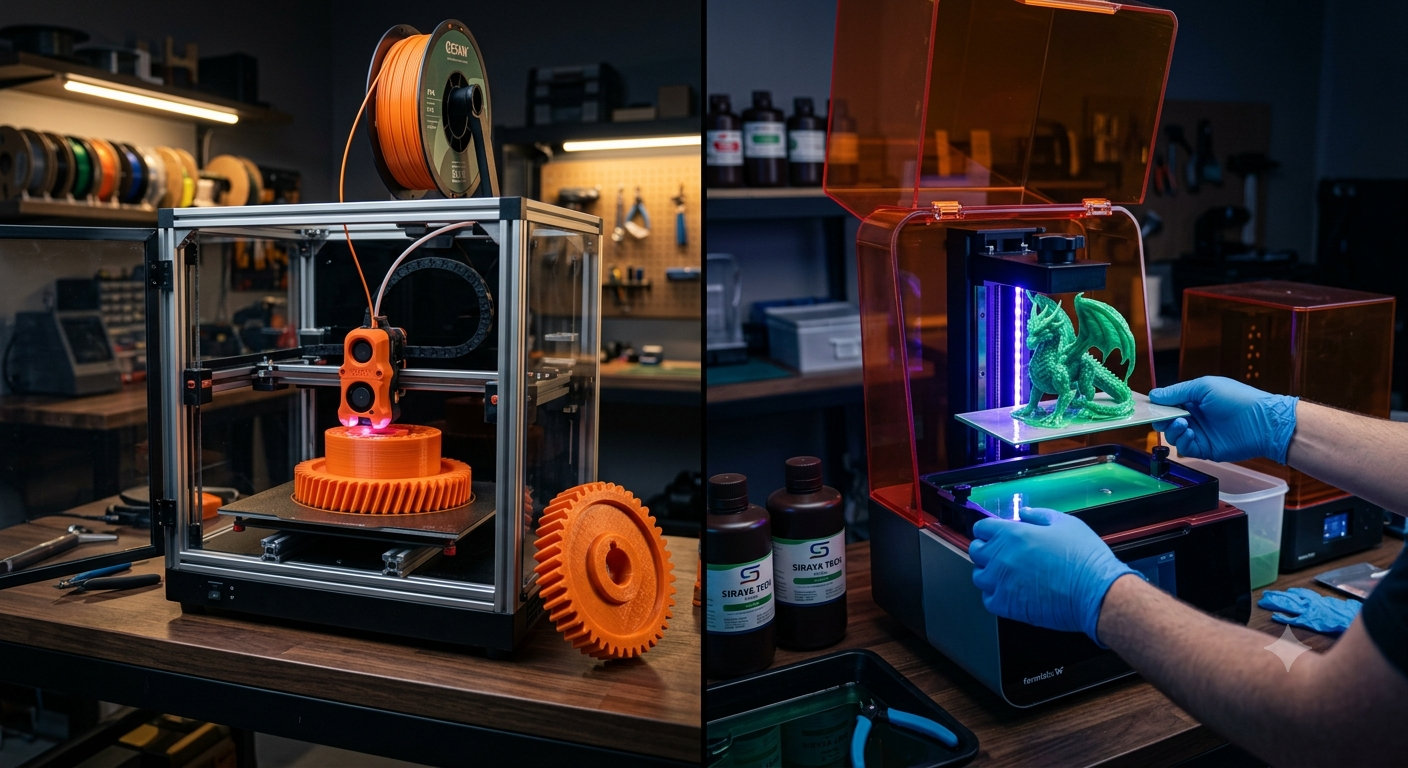
Choosing between resin and filament? Our 2026 guide compares print quality, strength, and total cost. Discover the perfect printer for your projects.
Resin vs Filament 3D Printer: The Ultimate 2026 Guide
Standing at the crossroads of the 3D printing world can feel overwhelming. On one side, you have the raw, mechanical promise of filament printers; on the other, the sleek, high-definition allure of resin. Your choice will define every project you undertake, from functional household repairs to stunningly detailed miniatures.
The core of the decision lies in understanding the fundamental differences between these two technologies. This guide cuts through the noise to deliver a comprehensive, practical comparison of resin vs filament 3D printers in 2026. By the end, you will have the clarity to choose the perfect machine for your workspace, budget, and creative ambitions .
Understanding the Core Technologies
Before diving into comparisons, it’s essential to understand how these two types of 3D printers actually work. They are fundamentally different processes, like comparing a potter’s wheel to a sculptor’s mold.
What is Filament 3D Printing (FDM)?
Filament 3D printing, widely known as Fused Deposition Modeling (FDM) or Fused Filament Fabrication (FFF), is the most common form of 3D printing for consumers and hobbyists .
How It Works: Think of it as a sophisticated, computer-controlled hot glue gun. The printer feeds a spool of thermoplastic filament through a heated nozzle. The nozzle melts the plastic and deposits it onto a build plate, tracing the cross-section of your digital model. Layer by layer, the object is built from the bottom up .
What is Resin 3D Printing (SLA/DLP)?
Resin 3D printing, which includes technologies like Stereolithography (SLA) and Digital Light Processing (DLP), is a photochemical process .
How It Works: Instead of melting plastic, a resin printer uses a vat of liquid photopolymer resin. A build plate is lowered into this vat, and a light source (a laser in SLA, or a projector screen in DLP/LCD) shines UV light onto the resin, curing it into a solid layer. The platform moves up, and the process repeats. This is often described as “growing” an object out of a liquid bath .
Head-to-Head Comparison: Resin vs Filament in 2026
To help you make an informed decision, let’s break down the battle between resin vs filament 3D printers across the most critical categories.
Print Quality and Detail: The Crown Jewel of Resin
This is where resin printers unequivocally win. If you need to print a miniature figurine, a piece of jewelry, or a dental model, the choice is clear.
- Resin Printers: Resin technology reigns supreme for detail. They achieve layer heights as small as 25 to 50 microns, resulting in surfaces that are incredibly smooth with virtually invisible layer lines . This allows for the reproduction of intricate details, sharp corners, and complex geometries that are impossible for filament printers to achieve out of the box . As the Ultimaker guide notes, resin printers can produce walls as thin as 0.2 mm and details as fine as 0.1 mm .
- Filament Printers: Filament prints feature visible layer lines, which is a result of the extrusion process. While modern machines are getting better, the resolution is limited by the nozzle size (commonly 0.4 mm). Using a smaller nozzle can improve detail but dramatically increases print time. A 3D printer using filament is perfectly adequate for functional parts and larger items, but it won’t win any beauty contests without post-processing .
Strength and Durability: Filament Takes the Crown
- Filament Printers: If you need a part that is robust, impact-resistant, and can handle mechanical stress, filament is your material. Standard filaments like PLA and PETG offer good strength, but the real power of filament printing comes from its diverse material selection. Materials like ABS, Nylon, and Polycarbonate (PC) are incredibly tough and durable. Filament printing is ideal for creating functional parts, jigs, fixtures, and end-use components .
- Resin Printers: Standard resin prints are excellent for detail but are notoriously brittle. They are more prone to cracking or shattering under stress. While specialty engineering resins are available to improve toughness, they are significantly more expensive. However, as mentioned, if you need a smooth, detailed part that won’t be under load, resin is perfect .
Cost: Initial Investment vs. Ongoing Expenses
Analyzing the cost of a resin vs filament 3D printer is about more than just the price of the machine. It’s a two-part equation: the initial investment and the ongoing material and maintenance costs.
| Filament 3D Printer | Resin 3D Printer | |
|---|---|---|
| Initial Cost | Entry-level: $175 – $300 | Entry-level: $175 – $250 |
| Professional: $1,750 – $7,000 | Professional: $2,200 – $8,850 | |
| Material Cost | Cheaper. A 1 kg spool of standard PLA typically costs ~$20 . | More expensive. 1 kg of standard resin can cost $30 – $45 . |
| Additional Supplies | Minimal. Occasional replacement nozzles and build plate adhesives are the main extras . | High. You’ll need gloves, isopropyl alcohol for washing, and a UV curing station. Replacement FEP films for the resin vat are also a recurring cost . |
Verdict: While the initial printer costs can be similar, filament 3D printing is significantly more cost-effective in the long run due to cheaper materials and minimal post-processing supplies .
Build Volume: Bigger is Better for Filament
- Filament Printers: If you want to print large items like cosplay props, helmets, or large architectural models, a filament printer is the only practical choice. FDM printers generally offer much larger build volumes. For instance, the Creality K2 Pro boasts a build volume of 300 x 300 x 300 mm , while others can go even larger.
- Resin Printers: Resin printers are typically limited to smaller build volumes. While large-format resin printers exist, they are significantly more expensive. Most consumer models are designed for printing small, detailed objects. Common build volumes are in the range of 130 x 80 x 160 mm .
Ease of Use, Safety, and Post-Processing
This is often the deciding factor for beginners. The post-processing workflow is where filament and resin part ways, each with distinct implications for your health and time.
- Filament (FDM) Printers:
- Ease of Use: Generally considered more beginner-friendly. They are largely “plug-and-play” with minimal setup .
- Safety: Much safer for home use. PLA filament is made from plant-based materials and is non-toxic. However, printing with materials like ABS or Nylon does release fumes, so ventilation is recommended .
- Post-Processing: Minimal. Your print is ready shortly after it finishes. You simply remove the print from the bed and snap off any support structures. Sanding or painting is optional for aesthetic improvements .
- Resin Printers:
- Ease of Use: Has a steeper learning curve. It requires careful handling of liquid resin, which is messy and requires more attention to detail .
- Safety: This is the biggest concern. Liquid resin is toxic and a skin irritant. You must wear nitrile gloves and a respirator, and the printer should be in a well-ventilated area, ideally not in a living space. A How-To Geek article on the topic highlights this as the primary reason for preferring filament .
- Post-Processing: This is where the resin vs filament 3D printing workflow differs most dramatically. A resin print isn’t finished when it comes off the printer. It’s still covered in uncured toxic resin. The “holy trinity” of resin post-processing involves: 1. Washing the print in isopropyl alcohol (IPA), 2. Removing supports, and 3. Curing the print under UV light to finalize its strength .
Which Technology is Best for Your Projects in 2026?
The choice between a resin vs filament 3D printer ultimately depends on what you intend to make. Let’s look at specific use cases.
Choose a Filament 3D Printer If You Want:
- Functional Parts & Prototypes: If you’re designing mechanical components, hinges, gears, or brackets, you need the strength of filament.
- Large-Scale Projects: Printing a full-size helmet, a cosplay prop, or a large vase? You need the build volume of an FDM printer.
- Affordability & Safety: For a beginner, or if you’re on a budget, filament offers a lower total cost of ownership and a safer, less messy experience.
- Everyday Household Items: Cookie cutters, custom brackets, phone stands, and repair parts are all perfect for filament.
- Material Variety: You want to experiment with specialized materials like flexible TPU, wood-infused, or carbon-fiber filaments .
Choose a Resin 3D Printer If You Want:
- Ultimate Detail and Smooth Finishes: You are printing miniatures, jewelry, character models, or dental models. The quality is unparalleled for these applications .
- High Precision and Accuracy: Your project requires incredibly fine details, sharp edges, and tight tolerances .
- Batch Printing Small Parts: You can fill the build plate with multiple small objects, and the print time remains the same as printing one object .
A Note on 2026 Trends
The gap between these technologies is narrowing. Filament printers are becoming faster, more reliable, and capable of producing higher-resolution prints than ever before, with models like the Flashforge Adventurer 5M Pro pushing speeds to 600 mm/s . Similarly, resin printers are becoming more user-friendly with automated washing and curing stations. However, the fundamental differences in material properties and process mean that neither technology will fully replace the other. Many professionals now adopt a hybrid approach: using a resin printer for display-quality models and a filament printer for durable, functional prototypes .
Frequently Asked Questions (FAQ)
1. Is filament 3D printing cheaper than resin 3D printing?
Yes, generally speaking, filament printing is significantly cheaper. The upfront cost for entry-level machines is similar, but the ongoing cost of filament is about half that of resin. Furthermore, you avoid the recurring costs of consumables like gloves, IPA, and FEP films, as well as the need for a dedicated washing and curing station .
2. Is filament stronger than resin 3D prints?
For most common materials, yes. Standard resin prints tend to be brittle and can shatter under impact. Filaments like PLA, PETG, and especially ABS, Nylon, and Polycarbonate are much stronger, tougher, and more durable for functional parts. However, there are specialized “tough” and “engineering” resins available that can offer similar strength, but at a premium price .
3. Which is faster—resin 3D printers or filament 3D printers?
It depends on what you’re printing. A resin printer can be faster for a single, highly detailed, small object because the print time is determined by the height of the object, not its complexity. A filament printer can be faster for large objects, where its ability to use thick layer heights speeds up the process. The filament workflow is faster overall because it lacks the extensive post-processing of resin .
4. Which type has the smoothest surface finish?
Resin 3D printing wins this category hands-down. The ability to print with layer heights as small as 25 microns results in surfaces that are smooth to the touch with virtually invisible layer lines. A filament 3D printer will always produce visible layer lines .
5. Is resin 3D printing safe for home use?
It can be, but it requires strict safety protocols. You cannot put a resin printer in a bedroom or living space without proper ventilation. You must always wear nitrile gloves when handling liquid resin and uncured prints, and you must have adequate ventilation or an enclosure to manage fumes. The post-processing area must also be clean and well-organized to prevent spills. Filament printing with PLA is far safer .
6. Can I use filament on a resin 3D printer?
No, absolutely not. Filament 3D printers and resin 3D printers are completely different technologies that use incompatible materials. A filament printer melts solid plastic; a resin printer cures liquid photopolymer. You cannot substitute one for the other .
7. What is the best type of 3D printer for a complete beginner?
For most beginners, a filament 3D printer is the recommended choice. It is safer, more affordable, easier to set up, and requires far less post-processing. This allows you to focus on designing and printing without the mess and safety concerns of working with toxic resin .
8. What is the best use case for a resin printer?
Resin printers are the undisputed champions for anything requiring high detail and a smooth finish. Their best use cases include printing tabletop gaming miniatures, character models, jewelry prototypes, dental models, and other small, intricate objects where quality is the primary concern .
Conclusion: Which Path Will You Choose?
The question of “resin vs filament 3D printer” isn’t about which technology is “better”—it’s about which one is better for you and your specific goals.
In the filament corner, we have the champion of practicality: strength, affordability, safety, and massive build volumes. It is the go-to choice for makers, engineers, and tinkerers who want to create functional, durable parts for real-world use.
In the resin corner, we have the king of aesthetics: unparalleled detail, silky-smooth surfaces, and incredible precision. It is the tool of choice for artists, jewelers, and designers who require the highest quality finish on intricate, small-scale objects.
Your next step is to reflect on the projects you envision yourself creating. Do you see yourself building useful gadgets and household solutions? Or are you dreaming of crafting beautiful, detailed models and miniatures?
